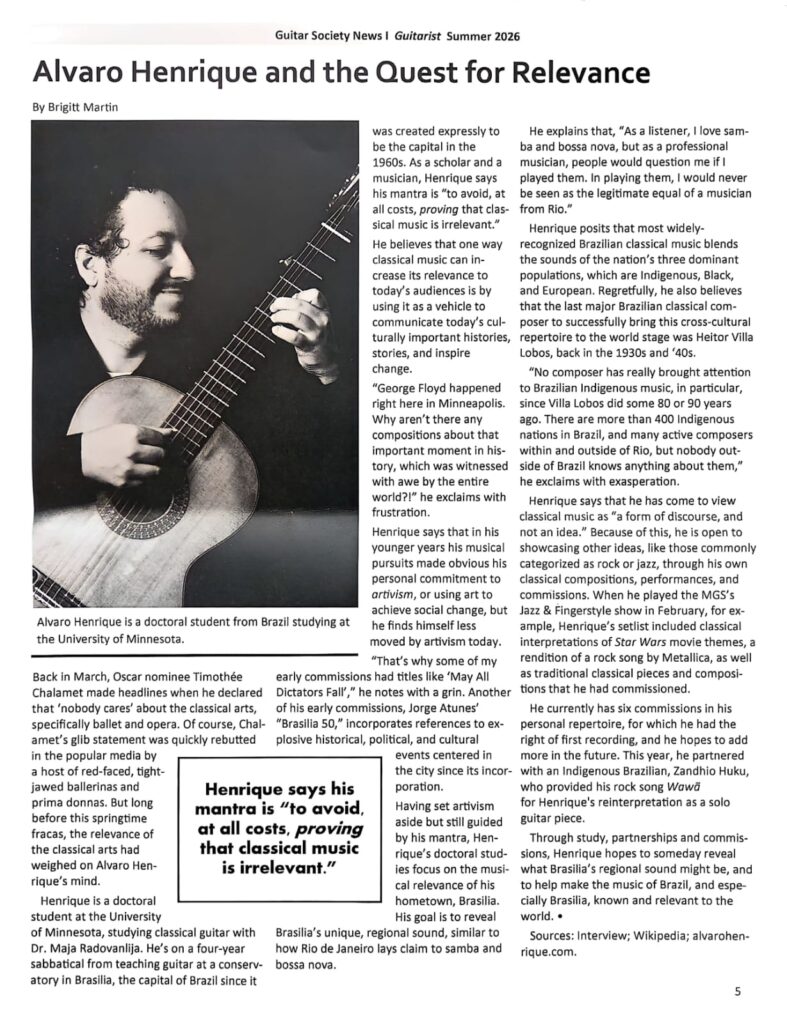
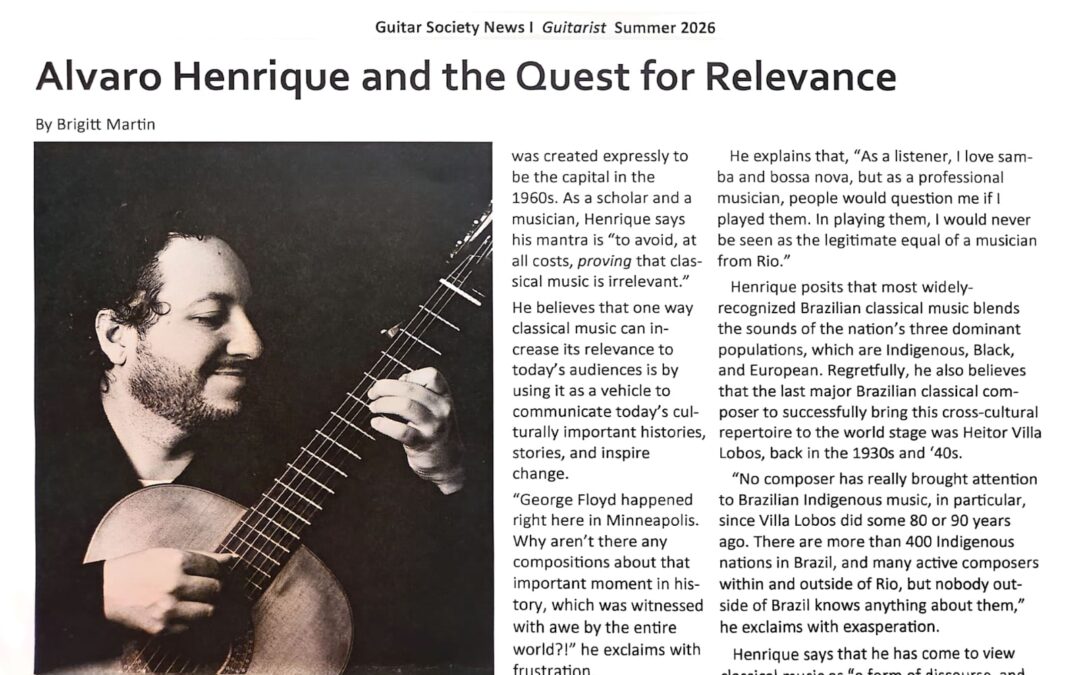
I was honored to be featured in the Summer 2026 edition of Guitarist, published by the Guitar Society News, in an article by Brigitt Martin exploring my artistic and academic work at the University of Minnesota. The story discusses my doctoral research on Brazilian music beyond the traditional Rio de Janeiro-centered canon, my interest in connecting classical guitar to contemporary cultural discussions, and my efforts to highlight underrepresented Brazilian voices — including Indigenous, regional, and peripheral traditions. The article also reflects on my belief that classical music must remain culturally relevant by engaging with today’s stories, identities, and audiences.
Guitar Society News | Guitarist Summer 2026
Alvaro Henrique and the Quest for Relevance
By Brigitt Martin
Caption under photo:
Alvaro Henrique is a doctoral student from Brazil studying at the University of Minnesota.
Back in March, Oscar nominee Timothée Chalamet made headlines when he declared that “nobody cares” about the classical arts, specifically ballet and opera. Of course, Chalamet’s glib statement was quickly rebutted in the popular media by a host of red-faced, tight-jawed ballerinas and prima donnas. But long before this springtime fracas, the relevance of the classical arts had weighed on Alvaro Henrique’s mind.
Henrique is a doctoral student at the University of Minnesota, studying classical guitar with Dr. Maja Radovanlija. He’s on a four-year sabbatical from teaching guitar at a conservatory in Brasilia, the capital of Brazil since it was created expressly to be the capital in the 1960s. As a scholar and a musician, Henrique says his mantra is “to avoid, at all costs, proving that classical music is irrelevant.”
He believes that one way classical music can increase its relevance to today’s audiences is by using it as a vehicle to communicate today’s culturally important histories, stories, and inspire change.
“George Floyd happened right here in Minneapolis. Why aren’t there any compositions about that important moment in history, which was witnessed in awe by the entire world?!” he exclaims with frustration.
Henrique says that in his younger years his musical pursuits made obvious his personal commitment to activism, or using art to achieve social change, but he finds himself less moved by artivism today.
“That’s why some of my early commissions had titles like ‘May All Dictators Fall,’” he notes with a grin. Another of his early commissions, Jorge Atunes’ “Brasilia 50,” incorporates references to explosive historical, political, and cultural events centered in the city since its incorporation.
Pull quote:
Henrique says his mantra is “to avoid, at all costs, proving that classical music is irrelevant.”
Having set artivism aside but still guided by his mantra, Henrique’s doctoral studies focus on the musical relevance of his hometown, Brasilia. His goal is to reveal Brasilia’s unique, regional sound, similar to how Rio de Janeiro lays claim to samba and bossa nova.
He explains that, “As a listener, I love samba and bossa nova, but as a professional musician, people would question me if I played them. In playing them, I would never be seen as the legitimate equal of a musician from Rio.”
Henrique posits that most widely-recognized Brazilian classical music blends the sounds of the nation’s three dominant populations, which are Indigenous, Black, and European. Regretfully, he also believes that the last major Brazilian classical composer to successfully bring this cross-cultural repertoire to the world stage was Heitor Villa Lobos, back in the 1930s and ’40s.
“No composer has really brought attention to Brazilian Indigenous music, in particular, since Villa Lobos did some 80 or 90 years ago. There are more than 400 Indigenous nations in Brazil, and many active composers within and outside of Rio, but nobody outside of Brazil knows anything about them,” he exclaims with exasperation.
Henrique says that he has come to view classical music as “a form of discourse, and not an ideal.” Because of this, he is open to showcasing other ideas, like those commonly categorized as rock or jazz, through his own classical compositions, performances, and commissions. When he played the MGS’s Jazz & Fingerstyle show in February, for example, Henrique’s setlist included classical interpretations of Star Wars movie themes, a rendition of a rock song by Metallica, as well as traditional classical pieces and compositions that he had commissioned.
He currently has six commissions in his personal repertoire, for which he had the right of first recording, and he hopes to add more in the future. This year, he partnered with an Indigenous Brazilian, Zandhio Huku, who provided his rock song Wawái for Henrique’s reinterpretation as a solo guitar piece.
Through study, partnerships and commissions, Henrique hopes to someday reveal what Brasilia’s regional sound might be, and to help make the music of Brazil, and especially Brasilia, known and relevant to the world.
Sources: Interview; Wikipedia; alvarohenrique.com.